Good  4 3 2 1 0  Poor

Operational Safety Services

OSART missionThe operational safety services provide advice on selected operational aspects and on safety management and safety culture of nuclear power plants:

OSART - Operational Safety Review Team

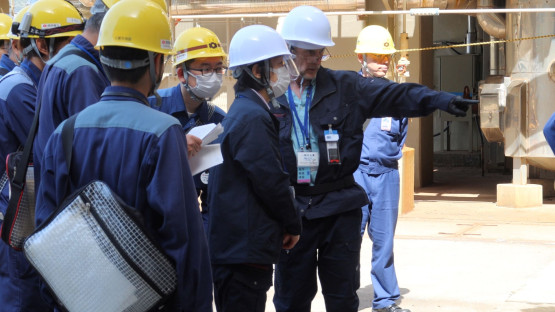
In 1982, the IAEA created the Operational Safety Review Team (OSART) programme. Under this programme, international teams of experts conduct in-depth reviews of operational safety performance at a nuclear power plant. They review the factors affecting the management of safety and the performance of personnel. As a result, the OSART programme has provided advice and assistance to Member States to enhance the operational safety of nuclear power plants. In addition, the OSART programme provides an opportunity to disseminate information on “Good Practices” which are recognised during OSART missions.

OSART missions in general review performance in the following areas:

  • Management, organization and administration
  • Training and qualification
  • Operations
  • Maintenance
  • Technical support
  • Operational experience feedback
  • Radiation protection
  • Chemistry
  • Emergency planning and preparedness
  • Construction, commissioning, etc.

Related information:

PROSPER - Peer Review of Operational Safety Performance Experience

To promote at individual NPPs the process and practice of learning from operating experience (either individual NPP experience, that of other NPPs or that of the industry at large) in order to enhance their safety performance. To encourage NPPs worldwide to perform self-assessments of the effectiveness of their operating safety performance experience review process. To benchmark/confirm, through an international Peer Review of NPPs' operational safety performance, that lessons are learned and acted upon and that these are disseminated nationally and internationally. To provide the necessary tools, methods and training to carry out these self-assessments.

Operational performance information comprises the following: external operating experience; internal event reports including internal low-level and near miss event reports; and other relevant operating performance information, such as performance indicators and non-compliance reports on quality assurance.

Related information: PROSPER Guidelines

IRS - International Reporting System

The International Reporting System for Operating Experience (IRS) is an international system jointly operated by the International Atomic Energy Agency (IAEA) and the Nuclear Energy Agency of the Organisation for Economic Cooperation and Development (OECD/NEA), through which thirty-one participating countries exchange experience to improve the safety of nuclear power plants by submitting event reports on unusual events considered important for safety.

The aim of the IRS is to increase the effectiveness in analysing and communicating operational safety experience.

Timely feedback of operational experience provides information on events useful in preventing similar occurrences at other plants. Shared experience is valuable in determining actions to be taken to mitigate the potential consequences of discovered design or operating weaknesses should an event occur. The lessons learned may also be incorporated into new designs for future generations of nuclear power plants.

As of 2006, the reports are accessible through the Web Based Incident Reporting System (WB IRS).

To reflect the evolution of the ‘Incident Reporting System’ to one which includes an expanded view/use of operating experience feedback, the name of the system was revised to ‘International Reporting System for Operating Experience’. The system will retain the term ‘IRS’.

Related information:

SALTO - Safety Aspects of Long Term Operation of Water Moderated Reactors Peer Review Service

The purpose of the Safety Aspects of Long Term Operation of Water Moderated Reactors Peer Review service is to assist Member States in ensuring the safe long term operation of nuclear power plants, and to promote the exchange of experience and information on good practices. The peer review addresses the strategy and key elements of long term operation and ageing management programmes.

Related information:

SCART - Safety Culture Assessment Review Team

The overall aim of Safety Culture Assessment Review Team (SCART) missions is to provide advice and assistance to Member States in the form of an in-depth independent review of safety culture at a Member State nuclear facility, to enhance the safety culture of the nuclear facility. SCART missions may be requested by various kinds of nuclear facilities in any stage of development - during commissioning, operation and decommissioning.

The SCART review process follows the IAEA Safety Standards and national or international good practices.

The key objectives of a SCART mission are to provide the host nuclear facility with recommendations in areas where safety culture should be improved to meet IAEA Safety Standards and international good practices, and to identify good safety culture practices at the host nuclear facility to be brought to the attention of other facilities around the world.

Approximately twelve to eighteen months after an initial SCART mission, a follow-up visit could be appropriate; special attention is given to reviewing the following topical areas:

  • Did the nuclear facility become more pro-active in its handling of the relationship between safety and production targets?
  • Were recommendations, suggestions and conclusions of the SCART review followed within a safety culture enhancement programme?
  • Was a more “blame-tolerant” culture in relationship to human error either introduced or further developed in the nuclear facility?

Related information:

Email us For further information please contact Operational Safety


| Last update: Wednesday, April 04, 2012.